|
제품 상세 정보:
|
| Item:: | Synthetic Ground Protection Bog Mat HDPE Temporary Truck Access Road Plate | Material: | High-Density Polyethylene |
|---|---|---|---|
| Color:: | White,Clear | Size:: | 1250*2500 mm, 1220*2440mm and customized |
| Thickness: | 12.7mm/15mm | Loading Weight:: | Up to 100ton |
| Working temperature::: | +85°C to -269°C | ||
| 강조하다: | 플라스틱 경로는 매트에 접근합니다,일시적 중장비 접근 매트,중장비를 위한 HDPE 도로 매트 |
||
Listing 37588078 - Ground Protection Mats
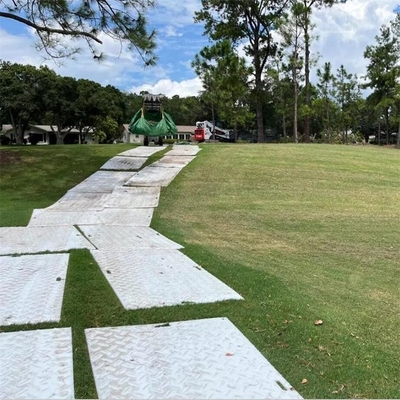
This listing is a temporary access mat in high-density polyethylene, laid on grass, mud or soft ground so that trucks, cranes and tracked plant can cross without sinking in. The recorded configuration is 1220 x 2440 mm or 1250 x 2500 mm, in 12.7 mm or 15 mm thickness, in White or Clear, with a load figure of up to 100 tonnes and a working temperature stated from +85 deg C down to -269 deg C.
Two conflicts have to be settled before those figures can be used. The description table ties its load reference to thickness, giving 60 tonnes at 12 mm, 80 tonnes at 15 mm and 100 tonnes at 20 mm, while the attribute record pairs a 100 tonne figure with 12.7 mm and 15 mm; the attribute record governs the listing, but because the description ties load to thickness the load must be confirmed against the thickness actually ordered. The working temperature of -269 deg C in the attribute record also does not sit with the same description table's embrittlement temperature of below -40 deg C, so the cold-end figure is treated as a recorded attribute awaiting confirmation, not as an established service limit.
| Recorded attribute | Value for this listing |
|---|---|
| Model number | Plastic Paths Access Mat |
| Manufacturer | Tangyin Taixing Engineering Plastics Co., Ltd. |
| Item | Synthetic Ground Protection Bog Mat HDPE Temporary Truck Access Road Plate |
| Material | High-Density Polyethylene |
| Size | 1250 x 2500 mm, 1220 x 2440 mm, and customized |
| Thickness | 12.7 mm and 15 mm |
| Colour | White, Clear |
| Loading weight | Up to 100 tonnes |
| Working temperature | +85 deg C to -269 deg C |
| Certification | ISO9001 |
| Place of origin | China |
| Minimum order quantity | 100 kilograms |
| Price | Negotiable |
| Payment terms | T/T, Western Union |
| Supply ability | 500000 kilograms per month |
| Delivery time | 15-20 days after deposit received |
| Packaging | Wooden crate or pallet |
The attribute record gives two base sizes. The description chart lists a wider set of formats with a load reference attached to three thicknesses. The two are kept apart below, because the chart is a reference table from the source and the attribute record is what this page is built on.
| Configuration | Recorded value | Status |
|---|---|---|
| Base mat sizes | 1220 x 2440 mm and 1250 x 2500 mm | Attribute record, governs this listing |
| Base thickness | 12.7 mm and 15 mm | Attribute record, governs this listing |
| Source size chart | 1220 x 2440 mm (4 x 8), 910 x 2440 mm (3 x 8), 610 x 2440 mm (2 x 8), 910 x 1830 mm (3 x 6), 610 x 1830 mm (2 x 6), 610 x 1220 mm (2 x 4), 1250 x 3100 mm | Description table, additional recorded formats |
| Load reference by thickness | 60 tonnes at 12 mm, 80 tonnes at 15 mm, 100 tonnes at 20 mm | Description table, linked to thickness; to be confirmed per order |
| Wide thickness band | 20 mm to 50 mm on the 1250 x 3100 mm format | Description table, outside the 12.7 mm and 15 mm base |
| Custom size | Size can be customized | Attribute and description agree |
The description table states four physical values. No test method or governing standard is recorded with them, so they describe the material as stated and are not presented as a test report for a delivered mat.
| Property | Recorded value | What it means on site |
|---|---|---|
| Water absorption rate | Below 0.01 % | The mat does not take up water and so does not gain weight in a wet yard |
| Compressive strength | At least 27 MPa | Wheel load carried through the mat into the subgrade |
| Shore hardness | 65 Shore | A hard face that spreads load rather than deforming around a tyre |
| Heat distortion temperature | 85 deg C | The upper end of the recorded service range |
| Embrittlement temperature | Below -40 deg C | The cold figure recorded in the description table |
The attribute record's -269 deg C cold limit and the description table's embrittlement temperature below -40 deg C are not the same statement, and only one of them can describe low-temperature service. Confirm the winter figure for the intended site with the manufacturer before relying on either.
How the mat carries a truck
A ground mat does not make soft ground strong. It spreads a wheel load over a larger area than the tyre footprint and keeps the wheel from cutting a rut, so the subgrade under it carries a lower pressure than it would under a bare tyre. That is why the recorded load figure is always qualified by ground condition in the description: the mat and the ground share the job, and a mat on a firm base behaves differently from the same mat on a bog.

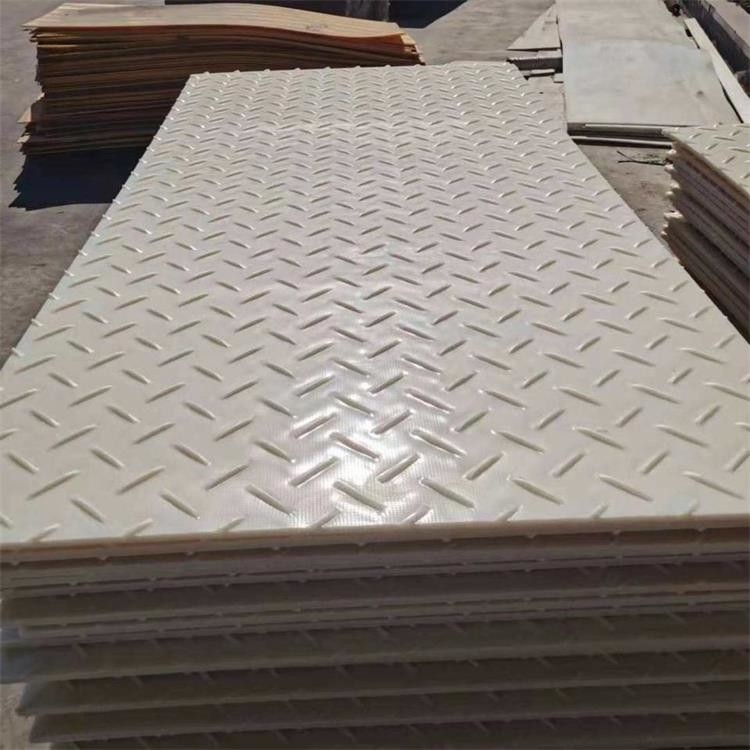
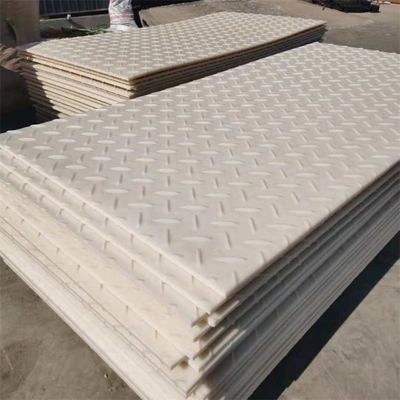
The description states that a rib pattern is moulded on both sides and prevents slipping even on soft ground and rough roads. The upper ribs are what a tyre keys into when the face is wet or muddy, which is the traction part of the claim. The lower ribs are what press into soft ground and stop the mat sliding forward under braking and steering, and they also give the mat somewhere to bed rather than sitting flat on a film of water. A smooth-faced mat on wet clay moves; a ribbed one resists that movement in both directions.
At 12.7 mm or 15 mm the mat is a stiff plate that bends to follow a soft subgrade without cracking, which is the behaviour the description calls flexible but unbreakable. The recorded compressive strength of at least 27 MPa and Shore hardness of 65 are what let the plate spread load instead of dimpling under a wheel. Because the description table assigns its load reference by thickness while the attribute record states a single figure of up to 100 tonnes, the thickness has to be chosen against the actual plant weight and the ground, and then confirmed with the manufacturer rather than read off the attribute line alone.
The description records two linking methods, a single connection and a double connection, and states that both are simple to install and make the mats more stable. Single connection joins two mats along one edge; double connection joins along both long edges, so an interior mat is held on both sides and the roadway behaves as a continuous surface rather than a line of loose plates. The joint is the weak line in any mat road: a butt joint that is not connected opens under turning wheels, and an open joint is where mud pumps up between the plates.
Handrails are moulded into the mat, and the description presents them as the feature that makes manual handling practical. On a 1220 x 2440 mm mat in 15 mm HDPE, the mass is more than one person should lift by the edge, so the hand-holds are what allow a two-person carry and a controlled drop into place. That is also why the mats are laid by hand in most yards rather than by machine: the handling feature defines the installation method as much as the size does.
White and Clear are the two recorded colours. Both are light, which keeps the mat visible on a dark yard and shows mud and damage early; a clear mat also shows the ground under it, which is useful when a mat is laid over grass that has to be checked for recovery. The rib pattern is the same on both.
Where the mat works and how it is laid
The recorded use is temporary truck access over soft ground, grass, swamp and difficult sites, and the description adds construction sites, festival grounds, golf courses and cemeteries where the surface has to be protected as well as crossed. In each case the mat is a temporary layer that is laid, used and lifted, not a permanent pavement.
A 1220 x 2440 mm mat at 12.7 mm or 15 mm suits a wheeled delivery, a crane pad access route, a temporary compound or a pedestrian and plant crossing over turf. The recorded working temperature tops out at 85 deg C, which is well above any ambient yard condition, so the upper limit is not the constraint on a normal site; the cold end is the figure that needs confirmation for a winter programme.
A mat is not a road. It does not drain a bog, it does not carry a load that the subgrade cannot take at all, and it does not replace a crane pad under an outrigger foot, because the package records no point-load rating for a stabiliser. It is also not a permanent surface: the ribs bed into the ground and the mat is designed to be lifted again. And no fire rating, chemical resistance rating or electrical rating is recorded for this listing, so it should not be used where any of those are specified.
Clear the line of sharp stones and debris first, because a mat laid over a projection rocks and the rib pattern cannot bed. Lay the first mat square to the route, then join the next mat on the long edge with the recorded single or double connection, and keep the joints staggered between parallel runs so that no continuous seam runs down the wheel track. Work from the firm end toward the soft end, so that the mats already placed carry the person laying the next one. Where the route turns, use the shorter formats from the recorded chart rather than cutting a full mat, because a cut mat loses its connector.
Lift the mats before the ground dries hard around them, and lift from the hand-holds rather than by the edge. Clean the rib faces before stacking, since mud trapped in the ribs is what makes a stack unstable in transport and what hides a crack. Inspect each connector on lifting: a cracked connector is the first sign of overload, and a mat with a damaged connector should not be put back into a roadway.
Factory and order
Tangyin Taixing Engineering Plastics Co., Ltd. manufactures this mat. The company records more than 20 years of experience, a plant area above 25,000 square meters and an annual output above 8,000 tons, and describes itself as an engineering plastics manufacturer combining production, sales, design and processing. The site profile and footer also name Beijing Silk Road Enterprise Management Services Co. for the same engineering-plastics business, which is one manufacturing and export organisation under two recorded names, not a separate plant.
HDPE ground protection mat is named in the company's own product range, alongside UHMWPE board, HDPE sheet, dual colour HDPE sheet and the machined product lines. The recorded equipment includes an imported production line, a moulding press machine, CNC precise finishing machines, a carving machine, a sander machine and CNC machining centres, with AutoCAD based design support. The ribbed face and the connector profile come from the moulding side; a custom outline or a modified connector position is a cutting and machining job on the CNC equipment, which is why a non-standard size can be quoted.
The laboratory is recorded with an abrasion tester, a universal mechanical tester and an oxygen index tester. The universal mechanical tester is the instrument behind the compressive and hardness values quoted for the HDPE material, and the abrasion tester relates to a face that is dragged over gravel and stone. No certificate number, issuing body or batch test report is recorded, so these are in-house instruments and not third-party certification.
ISO9001 is recorded for this product as a quality management system covering the manufacture of polyethylene sheet and machined plastic products. It is a system certification: not a product approval for this mat, not a load certification, and not a material test report.
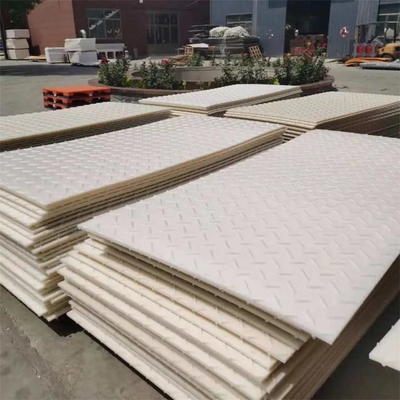
The minimum is 100 kilograms, a weight rather than a mat count, so a small trial run of one or two mats can be combined with other sizes to reach it. Supply ability is 500000 kilograms per month, which is a yard-programme scale, and delivery is 15-20 days after deposit received. Packaging is a wooden crate or pallet, which keeps a stack of mats square and keeps the connectors from being crushed. Payment is T/T or Western Union and the price is negotiable against size, thickness and colour.
Questions from site buyers
The Plastic Paths Access Mat carries a rib pattern on both faces. The upper ribs give a wet or muddy tyre something to key into, which is the traction half of the design, and the lower ribs press into soft ground and resist the mat sliding under braking and steering.
Both halves are needed on one mat, because a face that gripped only on top would still walk across a wet subgrade. The description states the ribs prevent slipping on soft ground and rough roads, and that behaviour is why a Plastic Paths Access Mat from Tangyin Taixing Engineering Plastics Co., Ltd. is laid rib-bedded rather than on a smoothed and sealed base.
The description records two linking methods for the Plastic Paths Access Mat: a single connection and a double connection. Single connection joins two mats along one edge; double connection holds a mat on both long edges, so an interior mat in a roadway is restrained on both sides instead of only one.
For a straight access route the single connection is enough at the outer edges, while a turning area or a heavy traffic lane benefits from the double connection on every interior Plastic Paths Access Mat from Tangyin Taixing Engineering Plastics Co., Ltd. The joint is the weak line in a mat road, and an unconnected butt joint is where mud pumps up between plates.
The attribute record for Plastic Paths Access Mat states a loading weight of up to 100 tonnes, while the description table links load to thickness and gives 60 tonnes at 12 mm, 80 tonnes at 15 mm and 100 tonnes at 20 mm. The attribute figure governs the listing, but the description's thickness link means the load has to be confirmed against the thickness actually ordered.
Load also depends on the ground, and the description says so directly by adding "depending on ground conditions" to its own figure. A buyer should give Tangyin Taixing Engineering Plastics Co., Ltd. the plant weight and the subgrade description, then take the Plastic Paths Access Mat thickness and load figure together in writing rather than as two separate numbers.
Handrails are moulded into the Plastic Paths Access Mat, and the description presents them as what makes manual handling practical. A mat of this size in high-density polyethylene is not a one-person lift by the edge, so the hand-holds are what allow a controlled two-person carry and a flat drop into position.
That handling feature sets the installation method: a yard laying Plastic Paths Access Mat by hand depends on the hand-holds more than on any other detail, and a mat dropped by one corner lands with a bent edge that no longer connects cleanly. It is worth checking the hand-holds on every mat from Tangyin Taixing Engineering Plastics Co., Ltd. at goods-in for that reason.
The attribute record states a working temperature for Plastic Paths Access Mat from +85 deg C to -269 deg C, and the description table separately records a heat distortion temperature of 85 deg C and an embrittlement temperature below -40 deg C. The two cold figures do not agree, and only one of them can describe low-temperature service.
For a normal site the upper figure is not the constraint, and the lower one matters only for a winter programme in a cold region. A buyer planning cold-weather use of Plastic Paths Access Mat should ask Tangyin Taixing Engineering Plastics Co., Ltd. to confirm the cold limit for the delivered mat, because the attribute record and the description table cannot both be relied on.
White and Clear are the two colours recorded for Plastic Paths Access Mat. Both are light, so the mat reads clearly against a dark yard surface and the edges of the route are visible to a driver; both also show mud, damage and a lifted corner earlier than a dark mat would.
A clear mat has the further property of showing the ground under it, which helps where the surface being protected has to be monitored for recovery. Colour does not change the rib pattern or the connector, so a Plastic Paths Access Mat from Tangyin Taixing Engineering Plastics Co., Ltd. can be ordered in either without altering the laying method.
The minimum for Plastic Paths Access Mat is 100 kilograms, a weight rather than a mat count. That lets a contractor order a short trial run for one crossing and add other sizes from the recorded chart to reach the minimum, and it keeps the entry cost low for a site that is not yet sure of its route.
Because the figure is weight, the quotation has to state the mat count and the total weight together. Supply ability of 500000 kilograms per month and delivery of 15-20 days after deposit received then set the programme for a larger Plastic Paths Access Mat order placed with Tangyin Taixing Engineering Plastics Co., Ltd.
The recorded packaging is a wooden crate or pallet, which holds a stack of mats square and protects the moulded connectors from being crushed in transit. A connector that arrives deformed will not join cleanly on site, and a deformed Plastic Paths Access Mat is difficult to correct without heat.
Mats should be stacked flat and not on edge, and the rib faces should be cleared of mud before stacking so that the stack does not sit on trapped grit. Check the crate count and the recorded size and thickness of every Plastic Paths Access Mat from Tangyin Taixing Engineering Plastics Co., Ltd. before the 15-20 day delivery window closes.
Four checks at goods-in
담당자: Mr. Sales
전화 번호: +86 152 1104 0646


 Korean